What to Send for a Pipe Support Quotation — and What You Can Skip
Most pipe support enquiries do not stall because the supplier is slow. They stall because a field is missing, the supplier writes back to ask, and two working days disappear into an email thread before anyone prices anything.
This note is the checklist we work from on our own quotation desk. Use it to assemble an enquiry that can be priced on first read — by us or by anyone else.
The minimum data set
Different support types need different fields. You rarely need all of them for one project.
| Field | Why it is needed | Can it be assumed? |
|---|---|---|
| Hot (operating) load per tag | Sets the spring size and working range | No |
| Vertical travel and direction | Sets load variability and the cold setting | No |
| Pipe size (NPS/DN) | Sizes the clamp or attachment | No |
| Design temperature | Material limits, insulation, finish | Partly — ambient can be assumed if stated |
| Arrangement | Hanger, base-mounted or trapeze | Yes, if headroom is described instead |
| Finish | Primer, epoxy or hot-dip galvanized | Yes — we quote primer unless told otherwise |
| Field | Why it is needed | Can it be assumed? |
|---|---|---|
| Pipe size and wall | Shoe width, saddle radius, weld detail | No |
| Insulation thickness | Decides shoe height — a 50 mm error makes the part useless | No, if the line is insulated |
| Design temperature | Hot or cold service; whether a thermal break is required | No |
| Axial / lateral movement | Guide clearance, slide plate length | Yes for anchors; no for guides |
| Steel grade or project spec | Plate and section material | Yes — carbon steel unless specified |
| Field | Why it is needed | Can it be assumed? |
|---|---|---|
| Pipe size per line item | The single field that sets the price | No |
| Quantity per size | Tooling, batch and packing | No |
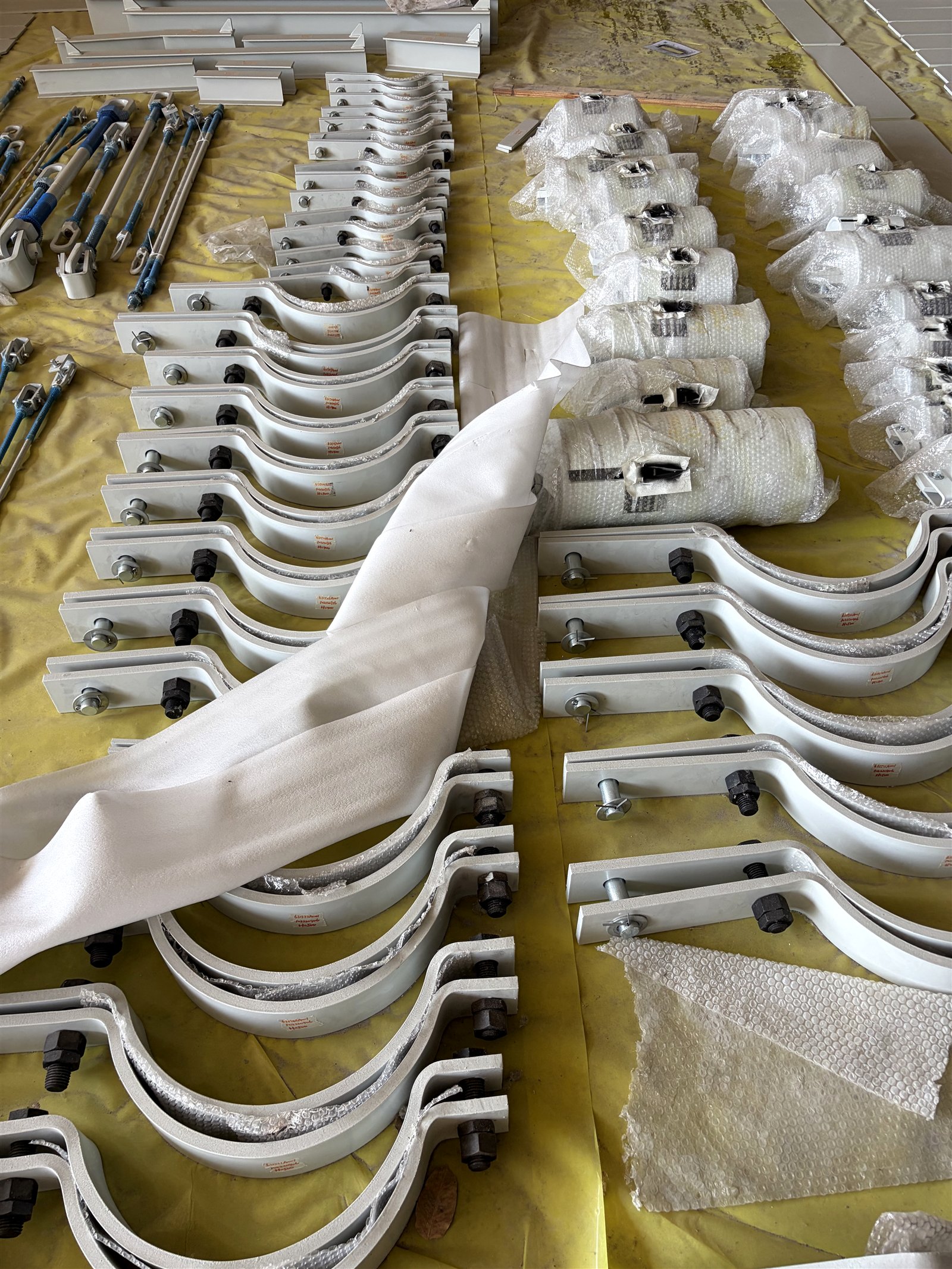
| Type | Two-bolt, three-bolt, clevis, insulated, etc. | Yes, if the application is described |
| Finish | Primer, epoxy or HDG | Yes — quoted both ways if unclear |
Formats that work
The data matters; the container does not. All of these are enough to start:
- A hanger schedule — the ideal case. One row per tag, priced line by line. See how to read a hanger schedule if you are building one.
- A marked-up stress isometric — loads and movements noted at the support points carry exactly the same information. A photograph of a marked-up print is fine.
- A BOQ extract — for bulk hardware, the support section of the bill of quantities is usually complete already.
- Nameplate photographs — for replacements in an operating plant. A legible nameplate carries load range, travel and often the original tag, which is enough to size a like-for-like unit.
- A plain list in the email body — for a handful of tags, typed lines work as well as a spreadsheet.
The three gaps that cause most delays
Across the enquiries that reach us, the same three fields go missing. None of them can be guessed:
- Travel without direction. "30 mm" does not say whether the pipe rises or falls going hot. The cold load moves in opposite directions for the two cases, so the installation setting cannot be issued.
- A load with no state. A single load figure with no note of hot or cold forces the supplier to assume — and an assumption on this field puts the spring at the wrong end of its range.
- Insulation thickness on shoe and clamp lines. An insulated line quoted as bare produces shoes that are the wrong height. This one is not recoverable on site.
What you can skip
- A full 3D model. Useful later, unnecessary for pricing. Loads and movements are what get priced.
- Final drawing approval. Preliminary loads are enough for a preliminary price; both get revised together.
- Your own model-number selection. If you have already selected sizes we will check them, but you do not need to. Give us loads and travel and we will size it — and say so if a tag needs a constant support instead of a variable spring.
What comes back
| Deliverable | Detail |
|---|---|
| Itemized quotation | Priced per tag or per line item, not a single lump sum |
| Data sheet per tag | Selected size, spring rate, hot and cold loads, travel, arrangement |
| Queries list | Any field we had to assume, stated explicitly so you can correct it |
| Lead time and packing basis | Working days from drawing approval; export crating included |
On our desk that turnaround is within 24 hours on working days for a schedule that arrives complete. Incomplete schedules get a preliminary price in the same window, with the gaps listed.
Copy-paste enquiry template
For a first enquiry, this is enough:
Standard or spec (e.g. MSS SP-58 or project spec):
Finish required (primer / epoxy / HDG):
Per tag:
Tag no. | Pipe size | Design temp | Hot load | Travel + direction | Arrangement | Insulation thickness
Bulk items:
Type | Pipe size | Quantity | Finish
Required delivery date:
Fill in what you have, leave the rest blank, and send it to sales@pipeanchorsupply.com or by WhatsApp. We will price what is priceable and list what is not.
Written by the PipeAnchor Supply team, based on the sizing and quotation practice at our manufacturing base in Deyang, Sichuan. Questions on a specific tag or schedule — including a second opinion on a selection you already have — go to sales@pipeanchorsupply.com (ShiQi “Alex” Zhuang, international sales) or WhatsApp +86 138 9024 1026. Published 28 July 2026.