Constant support or constant hanger?
This page covers base-mounted constant spring supports, which carry the load from below. A suspended constant spring hanger transfers the load through an upper suspension connection. Both belong to the constant-support family, but their installation envelope and load path differ. Confirm the required arrangement on the project support drawing.
Support or hanger — decided by the location
The constant mechanism is the same either way; what differs is where the load path starts:
- Overhead steel available → constant hanger. Suspended on a rod, loaded in tension.
- Line near floors, racks or foundations → constant support (this page). The unit stands under the pipe, loaded in compression, base plate bolted or welded down.
And one step before that: if the vertical travel is small, a variable spring support does the job at lower cost — constant units earn their price where travel is large enough that a variable spring's load change would exceed what the stress calculation allows.
Construction — MA mechanism, floor-standing frame
Inside the frame is the same main & auxiliary spring mechanism as our MA-Series constant hangers: the auxiliary spring group generates a force component that mirrors the main spring's deviation, and their superposition holds the supporting force constant by mathematics, not cam approximation. On the support arrangement that means:
- Load deviation ≤3% across the travel range, verified per unit on the load–travel bench (MSS SP-58 limit: 6%)
- Base frame bolted or welded to steel or foundation — mounting dimensions stated per tag
- Lateral damping from the auxiliary spring group — particularly useful on base-mounted units, where side loads cannot be shed by rod swing
- Load scale and travel indicator readable at grade; hydrotest stops and transport locks fitted
Heavy loads — multi-cell arrangements
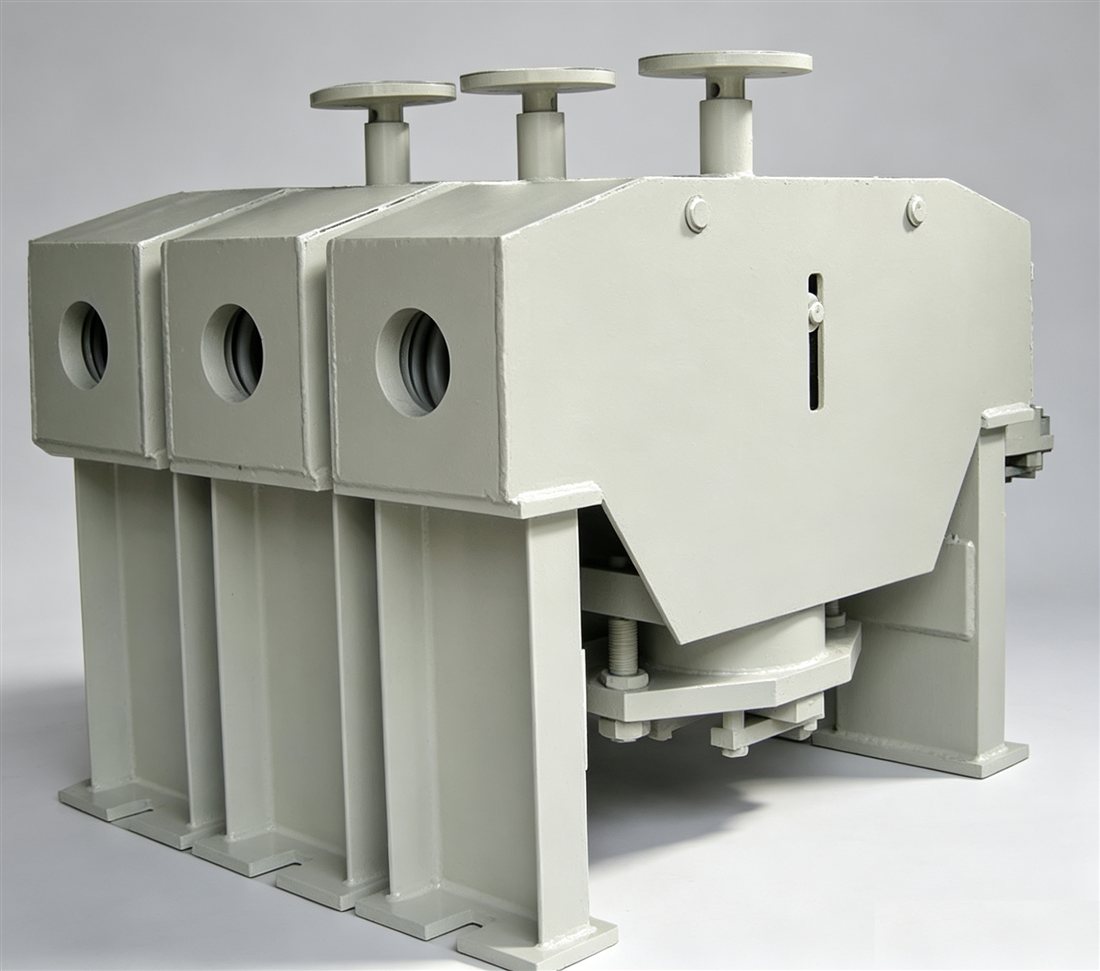
Where one load point exceeds the range of a single unit — large-bore steam lines, heavy valve stations, boiler components — two or more constant units are coupled in a common frame and share the load. The triple arrangement in the rendering above is typical. Multi-cell supports are engineered per tag: we confirm cell count, frame and mounting dimensions on the data sheet at quotation. A single unit stays the economical default wherever it covers the load — we will not quote you three cells where one does the job.
Typical Specification
| Item | Range / Detail |
|---|
| Design practice | MSS SP-58; project specs on request |
| Arrangement | Base-mounted; single or multi-cell |
| Load range | ~0.5 kN to 200+ kN per support |
| Travel | 25–300 mm typical |
| Load deviation | ≤3% bench-verified (MSS SP-58 limit: 6%) |
| Base & mounting dimensions | Stated per tag on the data sheet |
| Testing | Load-travel bench test report per unit |
Where they are used
Main steam and hot reheat lines routed low, rack piping over pipe bridges, heavy valve stations, and retrofit positions where the original suspension steel is gone or unusable.
Engineering resources
Frequently asked questions
When is a constant support used instead of a constant hanger?
When the line runs where it must be carried from below — near floors, on racks, over foundations — or where no overhead steel is available for suspension. The constant mechanism and sizing method are the same as the hanger version; the unit stands under the load instead of hanging above it.
When does a line need constant support rather than a variable spring?
When vertical travel is large enough that a variable spring's load change would exceed what the pipe stress calculation allows. A constant unit holds the supporting force effectively unchanged across the whole travel — on our MA mechanism, within 3% verified on the bench.
What are multi-cell constant supports?
Two or more constant units coupled in one frame to share a single heavy load point — used where the load exceeds the range of a single unit, typically under large-bore steam lines, heavy valves or boiler components. We size and quote them per tag; a single unit remains the economical default wherever it covers the load.
What information do you need to quote a constant support?
Hot load, total vertical travel with direction, pipe size and temperature, and the available height under the pipe. A hanger schedule or marked-up stress isometric is ideal — we return a sized data sheet per tag including base and mounting dimensions.
What documentation is provided with an order?
A load-travel bench test report per unit, a data sheet per tag with mounting dimensions, dimensional and inspection reports, material certificates on request, and export packing documents. Units ship locked at the cold position with hydrotest stops fitted.