Coatings & Finishes for Pipe Supports
Finish is the line item most often left blank on a support enquiry, and the one most likely to be wrong on site. It is treated as a paint decision — a preference, something to settle later. It is not. On a pipe support the finish is a design input, and on some lines the wrong one does more than corrode: it cracks the pipe.
This note sets out the four finishes we supply, the three questions that decide between them, and the one prohibition that overrides all of it.
The three questions that settle it
For the great majority of tags, the finish falls out of three answers:
- Where does it live? Indoor and dry, outdoor inland, coastal, wash-down area, or buried.
- How hot does it get? Not the process temperature — the temperature at the support, which on an insulated line is far lower than the fluid, and on a bare hot line is close to it.
- What is the pipe made of? Carbon steel, austenitic stainless, or a nickel alloy. This is the question that most enquiries omit, and the one that can invalidate the other two.
The four finishes, and what each is actually for
| Finish | What it is for | Where it fails |
|---|---|---|
| Red-oxide primer | Shop and transit protection. Correct where supports will be painted on site with the surrounding steelwork, or live indoors in a dry plant. | Treated as a service-life coating. Primer alone outdoors is a rust schedule, not a finish. |
| Epoxy systems | Chemical exposure, wash-down areas, and cases where a specific colour or a project paint spec applies. Good film build, good chemical resistance. | Handling damage. Paint protects only what it covers — a chipped edge on a clamp corrodes from that point outwards. |
| Hot-dip galvanizing | Outdoor and coastal carbon steel. Rack hardware, clamps, U-bolts, strut, building services steel in Gulf and marine air. Sacrificial: minor damage still protects. | Hot service, and any contact with austenitic or nickel alloy pipe — see below. |
| Bare stainless (304/316) | Where the environment or the pipe material rules out coated carbon steel: alloy piping contact faces, aggressive chemical service, permanently wet or hidden locations. | Budget. It is the honest answer where nothing else works, not a default. |
The zinc rule — the one that is not a preference
This is the part worth reading twice, because it is the difference between a finish that is suboptimal and a finish that cracks a pipeline.
Zinc in contact with austenitic stainless steel or nickel alloys at elevated temperature can cause liquid metal embrittlement. Molten zinc penetrates the grain boundaries of the alloy and the material loses its ductility — cracking that gives no warning and does not announce itself on a visual inspection. The same mechanism is recognised for lead and, in certain conditions, aluminium.
Which is why the specification for an alloy line will typically read something like: coatings in contact with the pipe shall not contain zinc, lead or aluminium. That single sentence rules out hot-dip galvanizing, zinc-rich primers, zinc plating and aluminium-pigmented paints on every component that touches the pipe — clamps, shoes, straps, shims, saddles.
Note also that the prohibition follows the contact, not the component. A galvanized U-bolt is unobjectionable on a carbon steel line two metres away and prohibited on the alloy line — same part, same shipment, different answer. Support schedules that state pipe material per tag catch this automatically; schedules that don't leave it to whoever unpacks the crate.
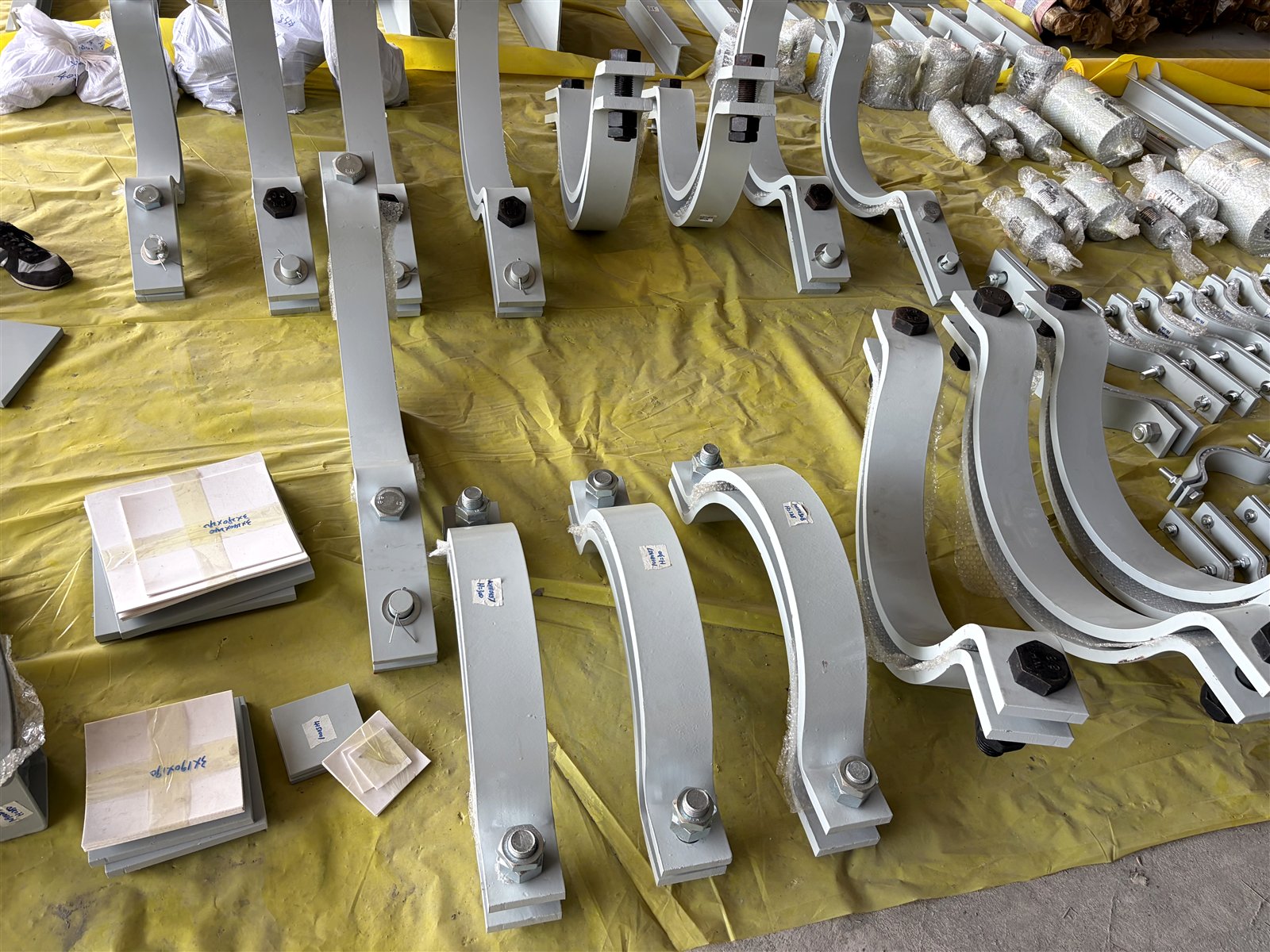
Hot service: why galvanizing stops being the answer
Hot-dip galvanizing is the default reflex for anything outdoors, and for good reason — on ambient carbon steel in coastal air, nothing else gives the same protection per dollar. But its usefulness narrows as temperature rises, and beyond a certain point the coating is no longer doing what the specifier assumed.
The practical consequence for support selection: on hot lines the finish decision moves away from galvanizing and towards heat-resistant paint systems, or towards materials that need no coating at all. Where the exact limit sits is a specification question — the project's paint spec or the coating supplier's data sheet governs, not a rule of thumb from a supplier's website, and certainly not ours.
Insulated supports: one assembly, two environments
An insulated pipe support straddles a boundary. The clamp, saddle and shims sit inside the insulation envelope, where condensation collects, air does not move, and nobody looks for the next ten years. The bracket, rod and structural attachment sit outside in the weather, where damage is visible and repairs are possible.
Specifying a single finish for the whole assembly usually gets both halves wrong — over-specifying the accessible outside and under-specifying the buried inside. The better instruction is a sentence, not a word: name the finish for components inside the insulation separately from those outside it. On coastal plant this is one of the cheapest reliability decisions available.
Coastal and Gulf plant: a note on what actually corrodes
In marine and Gulf environments the failures we hear about are rarely a coating failing on a flat surface. They start at:
- Cut edges and drilled holes made after coating — a field-drilled hole in a galvanized bracket is bare steel unless it is treated
- Welds made on site to coated components — the heat destroys the coating either side of the bead
- Crevices between bolted faces, where salt-laden moisture wicks in and never dries
- Handling damage in transit and at the laydown yard, which is why sacrificial protection outperforms barrier protection wherever parts get manhandled
None of these is solved by upgrading the finish specification. They are solved by minimising site modification of coated parts — which is an argument for getting the support dimensions right at the enquiry stage rather than trimming and drilling on site.
What to state on the enquiry
A finish specification that lets a supplier quote without coming back is usually one line per tag group:
Supports on SS/alloy lines → no zinc, lead or aluminium in contact with pipe; contact parts stainless or approved HT paint
Indoor plant room supports → primer only, site-painted with structural steel
Three lines. Everything else — dry film thickness, specific paint systems, colour, touch-up procedure — follows the project's paint specification, and if you have one, sending it saves a round of questions.
Frequently asked questions
Can galvanized pipe supports be used with stainless steel piping?
Not in direct contact, and not where the assembly runs hot. Zinc in contact with austenitic stainless steel or nickel alloys can cause liquid metal embrittlement — cracking that appears without warning. Specifications for alloy piping routinely prohibit zinc, lead and aluminium in any component touching the pipe. Use bare stainless, an approved high-temperature paint, or an isolating layer instead.
When is hot-dip galvanizing the right finish?
For outdoor and coastal carbon steel supports on lines that do not run hot — rack hardware, clamps, U-bolts, strut and building services steel in Gulf and marine environments. HDG gives sacrificial protection that survives handling damage, which paint cannot. It is not suitable in contact with austenitic or nickel alloy piping.
Is primer enough?
Primer is a shop and transit finish, not a service-life coating. It is right for supports that will be painted on site with the surrounding steelwork, or that sit indoors in a dry plant. For anything exposed to weather, salt air or wash-down, specify a full system at the enquiry stage.
What finish should insulated supports have?
Treat the support as two zones. Parts inside the insulation see condensation and no inspection for years; parts outside see weather and handling. One finish for the whole assembly usually over-specifies the outside and under-specifies the part you cannot see.
What do you need to quote a finish?
Environment, service temperature at the support, and the pipe material where the support contacts it. Those three settle the finish for most tags without further discussion.
Related reading
- What to send for a pipe support quotation — and what you can skip
- How to read a hanger schedule, column by column
- MSS SP-58 hanger types A–G, explained